
Why Storytelling Works for Science Learning
Children learn best when curiosity leads the way. Stories give science a heart, a context, and a reason to care.
Want to share this resource with your school, blog, or community?
Ferdi’s Pond welcomes partnerships, resource sharing, and thoughtful collaboration. Resources are shareable with proper attribution.
Long before worksheets and tests, humans learned through stories. We remembered patterns, seasons, animals, and water because they were woven into narrative.
For children, especially ages 6–10, storytelling turns abstract science concepts into lived experiences. A stream becomes a journey. A frog becomes a guide. An ecosystem becomes a community.
- Stories improve memory and comprehension
- Narrative learning increases engagement and emotional connection
- Children grasp systems more easily when they see cause and effect through story
- Curiosity-led learning supports deeper understanding than rote memorization
Educators and homeschool families have long known this instinctively.
“Story-based and hands-on learning significantly increases comprehension and retention, making narrative exploration an effective foundation for early science education.”
How We Use Storytelling at Ferdi’s Pond
At Ferdi’s Pond, science concepts unfold through original characters who live in a shared natural world.
- Ferdi the frog explores streams and change.
- Silas the turtle teaches water ecology with patience and care.
- Freddy the fritillary introduces insects through movement and observation.
Each lesson is designed as a guided adventure, not a lecture.
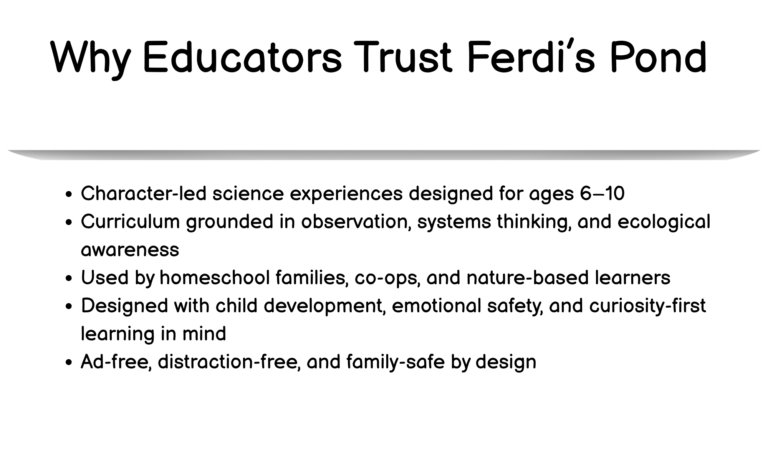
6+ guided learning modules across early childhood education, ecology, water science, insects, poetry, and nature observation
100% original characters and stories
Zero ads. Zero data selling. Child-first design
What Makes This Approach Different
-
No fast timers or pressure-based games
-
No disconnected facts without context
-
No fear-based environmental messaging
-
Designed to encourage stewardship, not anxiety
Who This Is For
- Homeschool families seeking gentle science learning
Educators who value narrative-based teaching
Parents of curious kids who ask “why” a lot
Children who learn best through imagination and connection
Free Resource: A Story-Based Nature Observation Activity
Download a simple guided activity families can use during a walk, at a pond, or in their own backyard.
Go on A Walk With Ferdi
Five Gentle Ways To Teach Ecology
Need tips on how to effectively teach ecology? Check out this resource HERE.
📚 Why Story-Based, Hands-On Learning Works
Educational and neuroscience research strongly supports the use of storytelling and active exploration when teaching science to children.
Key findings from peer-reviewed research show:
Active, experience-based learning leads to higher retention
Educational research consistently shows that learners retain significantly more information through hands-on, experiential learning than through passive instruction.
Research summarized across multiple studies shows retention rates of approximately 5% through lecture and up to 75% through practice-by-doing
Source:
- The Impact of Hands-On Approach on Student Academic Performance (ERIC) EJ1086006
- Old Dominion University: Hands-On Activities vs. Paper-and-Pencil Methods
🧠 STORYTELLING IMPROVES MEMORY AND UNDERSTANDING
A 2024 peer-reviewed study found that students who learned through storytelling-narrated learning experiences demonstrated significantly higher short-term memory retention compared to those who learned through lecture-narrated formats. Ginting, D., Woods, R. M., et al. (2024)
- The Effects of Digital Storytelling on the Retention and Transferability of Student Knowledge
Sage Open
💡THE BRAIN STORES KNOWLEDGE AS MEANINGFUL EXPERIENCES
Neuroscience research shows that the hippocampus forms memories by linking events into meaningful experiences. Conceptually rich stories activate emotional and interpretive brain regions, strengthening how memories are encoded and recalled.
Sheldon, S., et al. (2025), McGill University
How Storytelling Style Shapes the Way the Brain Forms Memories
Journal of Neuroscience
📊 STORYTELLING SUPPORTS COMPREHENSION AND ATTENTION
Educational studies show that storytelling improves children’s attention span, visualization, and cause-and-effect reasoning, helping learners build structured understanding rather than isolated facts.
A Guided Learning Companion
Ferdi’s Pond includes a friendly learning companion designed to support parents, educators, and curious learners as they explore science together. Ferdi helps answer questions, suggest age-appropriate activities, and guide reflection in ways that align with the story-based approach of Pond Pals Academy. He is not meant to replace teaching or exploration, but to support meaningful learning conversations with clarity and encouragement.
Ferdi does not search the internet or pull information from outside sources. His responses are guided by carefully defined knowledge boundaries and are limited to topics included within the Pond Pals Academy modules. As new modules are added, Ferdi’s knowledge grows alongside them. This ensures that guidance remains consistent, age-appropriate, and aligned with the educational philosophy of Ferdi’s Pond. Chat with Ferdi is located on every page and module. Ask him questions or ask for a story. Ferdi loves to tell stories!
Storytelling has always been one of humanity’s oldest teaching tools. We believe it still has a place in modern learning.
If Ferdi’s Pond feels like a resource your family or community would enjoy, you’re always welcome by the water.
My daughter loves One Rhyme At A Time! We read a chapter every night before bed. Silly Rhymes is also her favorite game!
- Deb N.
I wasn’t sure if my child would be interested in ecology, but Silas made it fun. Plus his voice is so soothing!
Now, he loves going outside to inspect our pond for debris. Thanks for igniting a love for water biomes into him!
- Janice S.
As a homeschool family, we’re always looking for science resources. Our children are on different levels, but all of them can learn from these modules. I love that it’s story driven and taught by the characters themselves. It’s helps them “get it” in a way that I can’t as “mom” Ferdi is a hoot sometimes!
We’ve bought the books and are looking forward to more!
- Cindy J.
All I can say is #TeamFerdi! We’re a frog loving family and Ferdi has become our favorite! We love how he was inspired by a real frog too. Stuart is awesome!
- Holly – Froglover
Work With Ferdi’s Pond
We love collaborating with educators, families, writers, and organizations who believe learning should feel curious, safe, and meaningful. Ferdi’s Pond is built around story-led, nature-centered learning, and we welcome thoughtful sharing and collaboration with like-minded communities.
We currently collaborate with and support:
Schools & Libraries
Classroom-friendly resources, reading connections, and story-based science explorationHomeschool Co-ops & Learning Groups
Gentle, flexible materials designed to support curiosity-driven learningEducational Bloggers & Writers
Access to resources, background information, and story-based learning materials for reviews or featuresNature Centers & Museums
Opportunities to connect story, science, and real-world observation
Resources may be shared for educational or informational purposes with proper attribution. Use of Ferdi’s Pond materials does not imply endorsement, partnership, or affiliation unless explicitly stated.
If you’re interested in collaborating, sharing resources, or featuring Ferdi’s Pond, we’d love to hear from you.
You’re welcome to share this page with families, educators, or learning communities.
Link:
https://ferdispond.com/learning-through-story/
Suggested citation:
Ferdi’s Pond (2025). Why Storytelling Works for Science Learning.
© 2025 Ferdi’s Pond | Pond Pals Academy
All content on this page is original and provided for educational and informational purposes. Content may be shared with proper attribution and a link back to ferdispond.com. Use of this material does not imply endorsement, partnership, or affiliation unless explicitly stated.
For collaboration, features, or media inquiries:
CONTACT FERDI'S POND